
The Food Truck of the Church | Guest: Rev. Robert Knuth
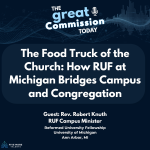

When Robert Knuth arrived in Ann Arbor in the fall of 2019 to plant Reformed University Fellowship (RUF) at the University of Michigan — the first RUF chapter in the state — he had no idea a global pandemic was six months away. Seven years later, what’s grown out of that uncertain start is one of the larger RUF ministries outside the Southeast, and a model for how campus ministry and the local church can work together for the long haul.
In this episode of The Great Commission Today, host Daniel Vos sits down with Knuth to talk about his own conversion story at a fraternity gathering, what it means for a campus ministry to operate under a presbytery rather than a single local church, and why he measures fruitfulness in decades rather than Wednesday night head counts.
Sowing Seed, Not Chasing Numbers
Knuth roots his approach to ministry in Mark 4’s parable of the sower. Campus ministry runs on a four-year cycle, and the day-to-day can feel urgent — students show up for a semester, disappear over the summer, graduate and move on. It would be easy to judge success by attendance at the Wednesday night large group. Knuth resists that temptation directly: when people ask how the ministry is going, his honest answer is, “ask me in 30 years.” Chasing weekly turnout, he says, is the opposite of a gospel that justifies by faith alone rather than by results.
The Food Truck of the Local Church
One of the most memorable images from the conversation is how RUF describes its own role: a food truck of the local church. A food truck doesn’t carry the full restaurant menu — RUF doesn’t baptize, administer the Lord’s Supper, hold membership, or exercise church discipline. But Knuth is seminary-trained, ordained, and sent by the Great Lakes Presbytery to represent the church on campus.
That distinction matters because the cultural gap between a college campus and an ordinary PCA congregation is real — different bedtimes, different income levels, different cultural assumptions. Knuth sees RUF’s job as building a bridge across that gap rather than either ignoring it or diluting the church’s identity to close it. Practically, that’s meant aligning RUF’s Wednesday night gatherings with the local church plant his family attends — same music, same rhythms — so students are unknowingly being prepared for what Sunday morning will feel like.
It’s also meant intentionally connecting with multiple PCA churches, not just one, since Michigan students scatter to Detroit, Grand Rapids, and Traverse City after graduation. Knuth points to denominational data to back up the strategy: the PCA was one of only two Protestant denominations to grow in 2024, and he credits much of that to ministries like RUF building these regional and national connections.
Teaching Students to Love an Ordinary Church
A recurring theme is the gap between what draws students to a church and what should keep them there. Ask a freshman why they go to a particular church, Knuth says, and they’ll usually point to the music or how relatable the pastor is — both of which, pressed honestly, could just as easily describe a Spotify playlist and a podcast. Knuth uses that observation to surface a deeper problem: a consumer view of church shaped by American individualism, where Sunday morning is something to consume rather than a body to serve.
Part of his work, then, is giving students categories for ordinary faithfulness — training them to love a church not because it’s flashy or has the best production, but because a tired, faithful pastor is showing up week after week to shepherd real people. He connects this directly to marriage: love isn’t sustained by always trading up for someone more attractive, and church commitment works the same way.
Leadership Development Through Ordinary People
Knuth is candid about how his own posture has shifted since being ordained at 27. Early on, he admits, he believed students simply needed him and his gifts. Years of ministry have reoriented him toward something less self-centered: students benefit far more from seeing ordinary church members — elders, deacons, regular working Christians — invest in them than from anything Knuth himself does from a stage.
He points to an elder from his local church who joined a student mission trip to Mexico City, not because it was his job, but because he wanted to. Or the “adopt-a-student” program through his church, which puts students in the homes of ordinary Christians who model what it looks like to live on mission while holding a regular job. Knuth’s read: students won’t remember his sermons nearly as much as they’ll remember being loved by ordinary, faithful church members.
The fruit shows up downstream, too. Of RUF Michigan’s three graduating classes so far, roughly 65% are attending confessional Reformed churches — and this fall, three graduates are headed to seminary (two to Reformed Theological Seminary, one to Covenant), part of what Knuth sees as a pipeline of future pastors at a time when the broader church faces a real shortage of pastoral candidates.
Meeting Gen Z Where They Are — On Instagram
The conversation closes on a practical note: social media. Knuth, who describes himself as “the least tech-savvy millennial there is,” admits he didn’t go to seminary to learn Instagram. But he’s also clear-eyed about its role: for many incoming freshmen, RUF’s Instagram page is the literal front door to the ministry. Outreach to incoming students now starts months before move-in, scanning incoming class pages each summer and following anyone with a Christian indicator in their bio.
His advice to pastors and ministry leaders listening: if your church doesn’t have an Instagram, get one. If it does, find a motivated teenager who understands the platform and give them the freedom to make it genuinely valuable — not just content for content’s sake.
A Relational Approach to Evangelism
On evangelism, Knuth pushes back gently against outside groups that arrive on campus with zeal but little patience, treating secular campuses as territory to be won rather than places where God may already be at work. RUF doesn’t run a fixed evangelistic program. Instead, staff and students build relationships through ordinary conversations — on the Diag, in dorm rooms, wherever the Spirit seems to already be moving — trusting, as Knuth puts it, that God has not forsaken any place or person.
Listen to the full conversation for more on Knuth’s own testimony, how RUF navigates campus ministry without a session, and what 65% seminary-bound graduation stats can teach the broader church about discipleship that plays the long game.